While My Daughter Fought for Her Life in the ICU, My Mother Forced Me to Leave Her Side to Help with My Sister’s Birthday. Dad Called Me “Dramatic,” My Sister Accused Me of Using My Child as an Excuse—But When My Daughter Woke from Her Coma, Her First Words Were, “Mom, I Got Hurt Because of Grandma.”


The word “Code Blue” hit the hallway like a gunshot. It echoed down the corridor—sharp, metallic, final. I froze for a heartbeat before my body remembered how to move. My shoes slapped the sterile floor as I chased the blur of scrubs ahead of me. The pediatric ICU door swung open, and for a moment, all I could see was white light and movement.
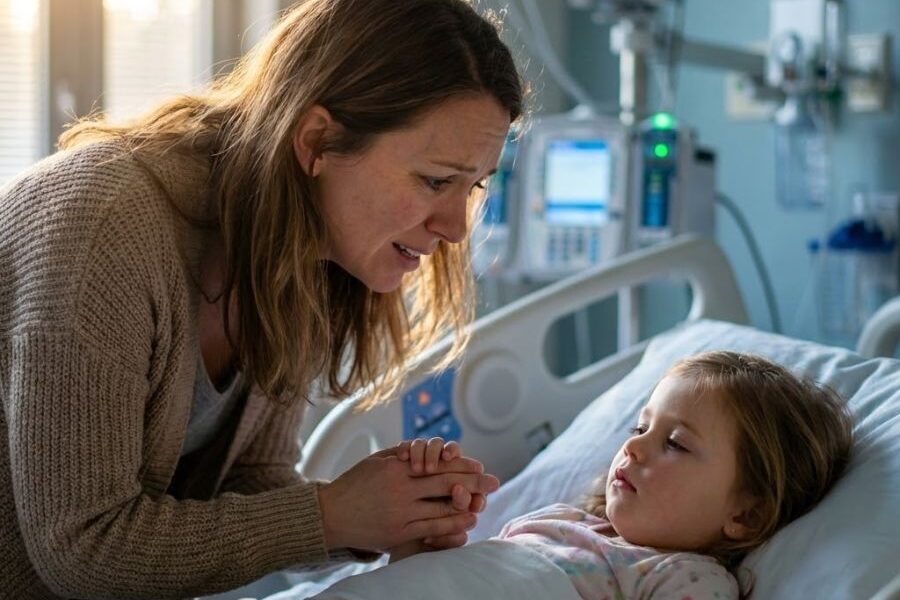
Three nurses surrounded my daughter’s bed. The rhythmic hiss of the ventilator was drowned out by the shrill alarm of her heart monitor. My little girl, my seven-year-old Meline, was hidden beneath a maze of wires and tubes. Her chest barely moved under the hospital blanket. The air smelled like antiseptic and panic.
“Ma’am, you need to wait outside.”
The nurse’s hand landed on my shoulder—firm, practiced, sympathetic. I tried to push past her. “That’s my daughter!” The words tore out of me like something feral.
“I know,” she said, calm but unyielding. “Dr. Battel is with her. Please, let us work.”
I stumbled backward until my knees buckled. The wall behind me caught my weight, and I slid down until I was sitting on the cold tile floor. My hands clutched the stuffed rabbit Meline had been holding in the car that morning, its left ear stained dark with her blood.
The hallway blurred. People rushed past, their shoes squeaking, their radios murmuring codes I didn’t understand. I pressed my forehead to my knees, whispering her name like a prayer I couldn’t stop repeating.
Three hours earlier, everything had been fine.
We’d driven to my parents’ house for Sunday lunch—a normal, lazy afternoon. My mother had called three times that week reminding me to come early. “We need to go over the decorations for Celeste’s birthday,” she said. “It’s going to be a big one.”
Celeste was my younger sister. She was turning thirty-five, and my mother was treating it like the royal wedding. Streamers, champagne, a three-tier cake. “It’s not just a birthday,” she’d said. “It’s a celebration of family.”
I didn’t argue. I never did with her.
When we arrived, Meline darted out of the car before I could even unbuckle my seat belt. She was chasing a butterfly, laughing, her sneakers flashing white against the pavement. I followed her up the driveway, but my mother was already calling from the porch. “Natalie! I need you in the kitchen. Come help me with these flowers.”
By the time I reached the sink, arranging lilies into a vase that didn’t need arranging, the scream cut through the air. A sound that split the day in half.
I ran outside, heart hammering so hard I thought I’d collapse before I got there. My father stood frozen beside his truck, his hands pressed to his temples, muttering, “I didn’t see her. Oh God, I didn’t see her.”
Meline lay motionless on the concrete, one shoe missing, a streak of red pooling beneath her head.
The paramedics came fast. I remember flashes—blue lights, a voice shouting “We’ve got a pulse,” my hands shaking so badly I couldn’t dial Nathan, my husband, the world collapsing around me while I stood in the center of it.
Now, twelve hours later, my daughter lay unconscious in the ICU, her small frame surrounded by machines that breathed for her.
I sat there for hours, numb, not moving except to wipe tears that wouldn’t stop coming. When my phone vibrated in my pocket, I almost didn’t look. But some part of me, still clinging to normalcy, made me pull it out.
It was my mother.
“Hello,” I said, my voice hollow.
“Natalie,” she said briskly, as though she were calling about groceries. “I’ve been trying to reach you. Tomorrow’s Celeste’s birthday. We need you here early—around nine. The caterer canceled, and we’ve got food prep and decorations to finish.”
I thought I misheard her. “Mom… Meline’s in the ICU. She’s—she might not—”
“I know,” she cut me off. “But sitting there won’t change anything. The doctors are doing their job. And Celeste’s party has been planned for months. I’m not letting it be ruined because you’re being dramatic.”
The phone nearly slipped from my hand. “Dramatic?” I whispered. “My daughter almost died today.”
“You’re exaggerating. Kids are resilient,” she said. Her voice was cold, clipped, like I was discussing a broken toy, not a child on life support.
“If you don’t come,” she continued, “I’ll cut you off from this family forever. Do you hear me? You’re always looking for excuses to make everything about you.”
In the background, my father’s voice joined hers, muffled but distinct. “Your sister’s day is more important than this nonsense. Stop the theatrics.”
Then Celeste’s voice cut in—sharper, meaner. “Stop using your kid as an excuse. You’ve always been jealous of me, Natalie. Just because Mom and Dad actually show up for me.”
Something inside me snapped then. I felt it—not breaking, but unhooking. Like a chain that had been pulled too tight for too long.
“No,” I said.
Silence. “What did you just say?” my mother asked, her voice suddenly low, dangerous.
“I said no,” I repeated, steadier now. “My daughter is fighting for her life, and you’re worried about a cake. Don’t call me again.”
I hung up before she could answer. Then I deleted all three numbers—my mother’s, my father’s, my sister’s.
For the first time in my life, the silence that followed felt like freedom.
An hour later, a nurse brought me a blanket and a paper cup of coffee that tasted like burnt metal. “She’s stable now,” the nurse said softly. “Vitals are improving. The swelling hasn’t worsened.”
I nodded, gripping the cup like it was an anchor. When she left, I leaned over Meline’s bed and took her hand. Her skin was warm, her fingers limp. I whispered to her about everything we’d do when she woke up—movie nights, pancakes on Sundays, that trip to the beach she’d begged for all summer. I told her I wasn’t going anywhere.
Sometime before dawn, exhaustion pulled me under.
When I opened my eyes, the room was full of morning light. Meline was still, her chest rising and falling in the slow rhythm of the ventilator. The world outside the window looked offensively normal—the parking lot half-full, nurses laughing quietly by the station.
I checked my phone out of habit. Seventeen missed calls. Thirty-one unread messages.
Every one of them from my family.
The first few were demanding. “You need to get here now.” “We can’t do this without you.”
Then they turned cruel. “You’ve always been selfish.” “You’re ruining everything.”
By 3 a.m., they had devolved into venom. “You’re dead to us.”
I read them all without flinching. Then I blocked every number.
The hours crawled by. Machines hummed. Nurses came and went. I sat in the chair beside Meline’s bed, holding her hand, whispering to her even when I wasn’t sure she could hear me.
Then—sometime around noon—her eyelashes fluttered.
I leaned forward so fast the chair nearly tipped. “Maddie?” I whispered, barely breathing. “Sweetheart, can you hear me?”
Her eyes opened, glassy and unfocused at first. Then they found me. Tears welled in her lashes before she could even speak.
“Mom,” she rasped, her voice weak and raw.
“I’m here, baby. I’m right here.”
She blinked slowly, like she was piecing her thoughts together. Then, so faintly I almost didn’t catch it, she whispered, “I got hurt because Grandma.”
The words hit me harder than any noise the machines could make.
“What do you mean?” I asked, my heart climbing into my throat.
Her little fingers tightened around mine. “Grandma told me to go outside,” she murmured. “She said there was a surprise in Grandpa’s truck. She said to look in the back seat. She said… don’t tell you. It’s a secret.”
“When did she say that?” I asked, my voice barely a whisper. “Was it when I was in the kitchen?”
Meline nodded weakly. “She said hurry, before you come back.”
The room went silent except for the sound of her breathing. I felt the weight of every word sink into my chest, heavy and cold.
I sat back in the chair, staring at the window where sunlight filtered through the blinds in thin, golden lines. My daughter lay before me, pale and fragile, the machines clicking softly in rhythm with her heartbeat.
And in that stillness, one thought began to take shape—a thought I couldn’t yet say out loud.
Continue below
Code blue, room 417. Code blue. The word sliced through the hospital corridor as I sprinted behind three nurses, my heart hammering against my ribs. Through the small window of the pediatric ICU room, I watched medical staff swarm around my seven-year-old daughter, Meline. Her tiny body looked impossibly small beneath the tangle of wires and tubes.
The ventilator beside her bed made a sound I will never forget. A rhythmic that seemed to mock every prayer I had whispered over the past 6 hours. A nurse pressed her palm against my chest, stopping me at the threshold. Ma’am, you need to wait outside. That’s my daughter. The words tore from my throat, raw and desperate. We know Dr.
Battel is doing everything possible. Please. I stumbled backward until my spine connected with the cold wall. My legs gave out and I slid to the floor, still clutching the stuffed rabbit Meline had been holding when the paramedics loaded her into the ambulance. The rabbit’s left ear was stained with her blood. 3 hours earlier, my life had been ordinary.
Meline and I had driven to my parents house for what was supposed to be a simple Sunday lunch. My younger sister, Celeste, was turning 35 the following day, and my mother, Priscilla, had insisted we come over to discuss party preparations. The accident happened in their driveway. My father, Warren, had been backing out his oversized pickup truck just as Meline ran behind it to chase a butterfly.
I had been inside helping my mother arrange flowers when I heard the scream. By the time I reached the driveway, my daughter was lying motionless on the concrete and my father was standing beside his truck with his hands pressed against his temples. I didn’t see her. He kept repeating, “I didn’t see her.” The ambulance arrived within 8 minutes, though each second stretched into an eternity.
Meline had suffered a traumatic brain injury, three fractured ribs, and internal bleeding. The doctors induced a coma to reduce brain swelling. And now, sitting on this hospital floor at 11 at night, I had no idea if my daughter would ever wake up. My phone buzzed in my pocket. I almost ignored it, but some reflexive part of me, the part that still functioned despite the terror, pulled it out.
My mother’s name glowed on the screen. Hello. My voice sounded foreign, hollowed out. Finally, I’ve been calling for hours. Priscilla’s tone was clipped, impatient. Listen, tomorrow is Celeste’s birthday party. I need you here by 9 to help with decorations and food prep. The caterer canceled last minute, so we’re doing everything ourselves.
I blinked at the phone, certain I had misheard. Mom, I’m at the hospital. Meline is in critical condition. She might not. I couldn’t finish the sentence. I know, I know, but there’s nothing you can do sitting there, is there? The doctors are handling it. Celeste’s party has been planned for months and I won’t have it ruined because you want to be dramatic.
The floor seemed to tilt beneath me. Dramatic? My daughter almost died today. She’s in a medicallyinduced coma. Tubes are keeping her alive. If you don’t come tomorrow, I’ll cut you off from this family forever. Her voice was ice. I mean it, Natalie. You’ve always put yourself first, and I’m tired of it.
In the background, I heard my father’s voice, distant, but audible. Your sister’s day is more important than this drama. Kids bounce back. You’re overreacting. Before I could respond, the phone shuffled and Celeste’s voice replaced my mother’s. Stop using your kid as an excuse. You’ve always been jealous of me, always trying to steal attention. Well, not this time.
This is my birthday, and you’re going to help whether you like it or not. Something inside me fractured. Not my heart, which had already shattered, but something deeper. The invisible chain that had bound me to my family for 32 years suddenly felt as flimsy as tissue paper. No. The word came out quiet, almost peaceful.
What did you just say? I said, “No. My daughter is fighting for her life and you’re worried about streamers and cake. Don’t call me again.” I hung up and without hesitation deleted my sister’s number. Then my mother’s, then my father’s. The pediatric ICU nurse found me an hour later, still sitting on the floor.
She brought me a blanket and a cup of terrible coffee and told me that Meline’s vitals had stabilized. The immediate crisis had passed, but she remained in a coma. The next 48 hours would be critical. I spent the night in a chair beside Meline’s bed, holding her hand and whispering stories about the adventures we would have when she woke up.
At some point, exhaustion dragged me into a fitful sleep. The next morning, Celeste’s birthday, I woke to find Meline unchanged. The monitors beeped their steady rhythm. The ventilator hest. Outside the window, the sun rose as though the world hadn’t come undone. My phone, which I had silenced but not turned off, showed 17 mis calls and dozens of text messages.
Most were for my mother, escalating from demands to threats to what I can only describe as verbal assault. One message called me a selfish, ungrateful daughter. Another accused me of always needing to be the victim. The final one, sent at 3:00 in the morning, simply said, “You’re dead to us.” I read each message with a strange detachment as though they were addressed to someone else.
Then I blocked every number. Around noon, Meline’s eyelids fluttered. I lunged forward, nearly knocking over the fourth stand. “Maddie, baby, can you hear me?” Her eyes opened slowly, painfully, and found mine. Tears filled down her cheeks before she even spoke. “Mom.” Her voice was barely a whisper, raspy from the ventilator tube that had been removed an hour earlier.
“I got hurt because Grandma.” My blood went cold. What do you mean, sweetheart? Grandma told me to go outside. She said there was a surprise in Grandpa’s truck. She said to look in the back seat. The room seemed to shrink around me. When did she tell you this? When you were in the kitchen? She whispered it. She said it was a secret. I sat back, my mind racing.
My mother had sent Meline outside. My mother had sent her toward the truck. My father had been backing out at that exact moment. A coincidence? Every instinct screamed that it wasn’t. I flagged down Dr. Patel and explained what Meline had told me. He listened with growing concern, then called the hospital’s social worker.
Within the hour, a police officer arrived to take Meline’s statement. She repeated her story with the clarity of a child who had no reason to lie. Grandma had whispered that there was a surprise in Grandpa’s truck, told her to keep it secret, and sent her running outside. The officer’s expression remained neutral, but his pen moved quickly across the notepad.
Ma’am, I have to ask, do you believe your mother intended for your daughter to be harmed? The question hung in the air, monstrous and impossible to answer. Did I believe my own mother had deliberately tried to hurt my child? I thought about the years of favoritism. Celeste had always been the golden child, prettier, more agreeable, easier to love.
I had been the difficult one, the stubborn one, the daughter who asked too many questions and refused to fall in line. My mother had never hidden her preference, but I had always attributed it to personality differences, not malice. Now, a darker pattern emerged. 3 years ago, I said slowly, I inherited a significant sum from my grandmother, my father’s mother.
She left everything to me and nothing to Celeste. My mother was furious. She said the inheritance should have been split evenly, that I had manipulated grandma against my sister. The officer leaned forward. How significant was this inheritance? $2.3 million. His eyebrows rose.
And your daughter Meline, is she your only child? Yes. Would she be your sole beneficiary if something happened to you? The question hit me like a physical blow. I had never updated my will after the inheritance. If I died, everything would go to Meline. And if Meline died first, I grabbed the officer’s arm. My sister. If Meline had died in that accident, who would inherit if something happened to me? He didn’t answer immediately. He didn’t have to.
When I was 17, before my grandmother’s inheritance was even a possibility, my mother had convinced me to sign a boilerplate estate document naming Celeste as my backup beneficiary. I had forgotten about it entirely until this moment. If Meline was gone and I had an accident of my own, Celeste would receive everything.
The investigation expanded rapidly. Detective Lorraine Huang arrived at Meline’s hospital room the following morning with a notepad and a gentle demeanor that belied the intensity of her questions. She interviewed Meline three separate times. Each conversation recorded with my consent. My daughter’s story never wavered. Grandma had whispered.
Grandma had sent her outside. Grandma had called it a secret surprise. Children rarely fabricate details this specific. Detective Wong told me privately. The whispered instruction, the secrecy, the precise timing. If she were making this up, she’d likely tell a simpler story. I nodded, though part of me still resisted the obvious conclusion.
This was my mother, the woman who had braided my hair before school, who had packed my lunches, who had sat beside my bed when I had the flu. Could that same woman have orchestrated my daughters near death? The answer came in fragments over the following days. Detective Hong obtained a warrant for my parents electronic devices.
My father surrendered his willingly, still shell shocked from the accident and desperate to cooperate. My mother, however, attempted a factory reset her phone before handing it over. The forensic technology unit recovered the deleted data. Anyway, what they found painted a portrait of premeditation that made me physically ill.
3 weeks before Celeste’s birthday, my mother had texted my sister, “Make sure the party is scheduled for Sunday and will bring M to help with preparations. W always backs the truck out around 2 p.m. for his golf game. Timing is everything.” Celeste had responded, “What if she doesn’t bring her?” My mother’s reply, “She will. I’ll insist on it.
I’ll tell her we need help with flowers. I read the transcript in Detective Hongs office, my hands trembling so violently that the pages rattled. The detective watched me with careful sympathy, allowing me time to process each revelation. There’s more, she said quietly. The search history on my mother’s laptop stretched back 18 months.
She had researched traumatic brain injuries in children, survival rates for pediatric accidents, how long medically induced comas typically lasted, and most damning of all, how to make an accident look convincing. She had read articles about insurance investigations, studied cases where parents were suspected of harming children, and taken notes on how perpetrators had been caught.
Her notes, recovered from a password protected document, included a section titled mistakes to avoid. Celeste’s digital footprint was equally incriminating. Her searches focused on inheritance law, particularly statutes governing what happened when a beneficiary died before receiving their inheritance. She had bookmarked articles about challenging wills, contesting estates, and the legal process for claiming assets from deceased relatives.
The spreadsheet I had heard about, the one titled after N is gone, contained detailed calculations. My grandmother’s estate, the projected growth of investments, the division of assets. There were columns for different scenarios. M dies, N survives. N dies, M survives. both die. Each scenario included projected payouts and timelines.
I stared at that spreadsheet for a long time, trying to reconcile these cold calculations with the sister who had taught me to ride a bike, who had shared secrets with me under blankets during thunderstorms, who had cried at my wedding. That sister, I realized, had never existed. Or perhaps she had existed once before greed corrupted everything she might have been.
While Meline continued her recovery, each day bringing small improvements that felt like miracles, I began piecing together my own history with new eyes. My best friend Caroline came to the hospital on the third day. She brought coffee and sandwiches and the kind of quiet presence that requires no conversation.
We sat together in the family waiting room watching the sunset through grimy windows and I told her what I had learned. I keep thinking about all the times I almost died. I said, “I always thought I was clumsy, accidentrone, unlucky. But what if none of it was accidental?” Caroline sat down her coffee. What do you mean? I listed the incidents.
The basement stairs at 12, the bicycle accident at 9, the car at 14, the food poisoning at 16. As I spoke, more memories surfaced. The camping trip when I was 10, where I had somehow wandered away from the group and gotten lost for 6 hours in increasingly dangerous terrain. The swimming lesson at 8, where I had nearly drowned after inexplicably forgetting how to float, something I had mastered weeks earlier.
The allergic reaction at 11 to a food I had eaten dozens of times before without incident. Every few years, I said slowly, something nearly killed me. And every single time my mother was nearby, present, but not quite close enough to prevent it. Always arriving just a moment too late to help, but early enough to appear concerned.
Caroline’s face had gone pale. Natalie, that’s insane. I know, but the pattern is there. I just never saw it because I couldn’t imagine my own mother wanting me dead. The next morning, I called my aunt Lucille again. She answered on the first ring as though she had been waiting. Our conversation lasted 3 hours.
She told me things about my childhood that reframed everything I thought I knew. My mother, Lucille explained, had always been jealous of me. Not in the normal way that siblings sometimes resent each other’s children, but with an intensity that bordered on obsession. From the moment I was born, Priscilla had complained that I received too much attention from their parents.
When I showed early academic promise, she had dismissed it as showing off. When I formed a close bond with my grandmother, she had tried repeatedly to poison the relationship. Your grandmother saw through Priscilla years before anyone else, Lucille said. She told me once that she feared for your safety.
I thought she was being dramatic. Your mother always seems so loving in public, so devoted. But Elellanar knew something was wrong. She felt it. Why didn’t anyone do anything? Lucille Sai carried decades of regret. What could we do? There was no proof. Your accidents always looked like accidents. Priscilla always appeared devastated when you got hurt.
She was a master at playing the concerned mother while simultaneously engineering your destruction. By the time I witnessed what happened on those basement stairs, I had already convinced myself that I was the paranoid one, the one seeing monsters where none existed. I rationalized what I saw because the alternative was too horrible to accept.
I understood. I had done the same thing my entire life. There’s something else, Lucille continued, her voice dropping, something I’ve never told anyone. The something else was about my uncle Theodore. I had grown up hearing the story of his death. a tragic hunting accident when I was a toddler, a misfired rifle, a life cut short at 29.
Theodore had been my grandmother’s only son, heir to the family business and fortune. After his death, the inheritance had passed to his children, except Theodore had no children. He had been engaged to a woman named Patricia, but they hadn’t married yet. So, the estate remained with my grandmother to be distributed according to her will.
Theodore was supposed to marry Patricia 3 weeks after that hunting trip. Lucille said, “If he had lived, if they’d had children, those children would have inherited everything. Your grandmothers will would have gone to Theodore’s family, not to her grandchildren through the female line.” I processed this slowly.
“You’re saying his death benefited my mother? His death benefited whoever stood to inherit if he was removed from the picture.” “At the time, that was your mother and me. We were the only other potential heirs.” Lucille paused. “I never wanted the money. I told your grandmother to leave my share to charity.
But Priscilla, she married your father 6 months after Theodore died. She was pregnant with Celeste within a year. It was like she was racing to produce heirs to secure her position in the family. Was she at the hunting trip? She claimed she wasn’t. But I’ve always wondered. There were so many people there, so much chaos after the shot.
Anyone could have slipped away unnoticed. I brought this information to Detective Hang, who listened with a professionally neutral expression I had come to recognize. She made notes, asked clarifying questions, and told me that while my uncle’s death had been ruled accidental decades ago, she would request the original case file.
“I won’t promise anything,” she said. “Cold cases are difficult, especially ones this old. But if there’s evidence to be found, well find it.” Over the next 3 days, while Meline slowly recovered in the hospital, detectives uncovered a web of evidence that made my stomach turn. My mother’s phone records showed extensive searches for inheritance laws, child beneficiaries, and what happens to trust when minor dies.
Celeste’s computer contained similar searches along with a spreadsheet calculating my grandmother’s estate distribution, but the most damning discovery came from an unexpected source. My aunt, my mother’s sister, Lucille, contacted me on the second day of the investigation. She had seen the news report about Meline’s accident and wanted to check on us.
When I told her what Meline had revealed, she went silent for a long moment. Natalie, I need to tell you something. I should have said this years ago, but I thought I convinced myself it was paranoia. Her voice trembled. “Do you remember when you were 12 and fell down the basement stairs at your parents’ house? You broke your arm and spent 3 weeks in a cast.
” “Of course, it was an accident.” “No, honey, it wasn’t.” Lucille exhaled shakily. “I was at the house that day. I saw your mother follow you to the basement door. I saw her arm move just before you fell. I convinced myself I had imagined it. Priscilla is my sister, for heaven’s sake. But I’ve never forgotten the look on her face when you hit the bottom.
It wasn’t horror, Natalie. It was satisfaction. My childhood reframed itself in an instant. The bicycle accident when I was 9, which happened right after my mother handed me a water bottle, she insisted I drink. The car that nearly hit me at 14 when my mother had sent me to retrieve something from across the street at the exact moment a vehicle came speeding around the corner.
The food poisoning that hospitalized me at 16 from a meal only I had eaten. I had spent my entire life being near merely killed by my own mother. The police brought Priscilla and Celeste in for questioning. My father, it turned out, had been completely unaware of his wife’s schemes, a fact confirmed by his genuine devastation when confronted with the evidence.
He cooperated fully with investigators, providing bank records and email access that further incriminated my mother and sister. What emerged was a conspiracy that spanned decades. My mother had always resented my grandmother’s wealth and her clear preference for me. She had planned since my childhood to eventually have me removed and claimed the inheritance through Celeste.
The accident at 12 was meant to kill me outright. When it failed, she grew more patient, more cunning. She waited for my grandmother to die, for the inheritance to come through, for me to have a child who could serve as a more vulnerable target. Celeste, I learned, had known about the plan since she was 20.
She had been an active participant, helping research methods and provide alibis. The spreadsheet on her computer was titled after N is gone and being the initial of my name. The arrest happened 5 days after Meline woke up. I was in Meline’s hospital room when Detective Hong called to inform me.
My daughter had graduated from the ICU to a regular pediatric ward and she was sitting up in bed working on a puzzle that Caroline had brought. The normaly of the scene, my child doing a puzzle, sunlight streaming through the window, the quiet beep of monitors, contrasted so sharply with the words coming through my phone that I had to step into the hallway.
We’ve made arrests, Detective Hong said. Your mother and sister are in custody. They were taken into custody about an hour ago. Both of them? Both? Your mother was at home. Your sister was at work. The charges include conspiracy to commit murder, attempted murder of a minor, and child endangerment. There may be additional charges depending on what the grand jury decides.
I leaned against the hallway wall, watching nurses passed by with medication carts and clipboards. The ordinary machinery of hospital life continued around me while my family imploded. What happens now? Arraignment tomorrow morning. They’ll enter, please. Bail will be set. Given the severity of the charges and the evidence we’ve accumulated, I’d expect the judge to set bail high.
Your mother is a flight risk, she has the resources to disappear. That evening, the story broke on the local news. I watched the coverage from Meline’s hospital room. The volume turned low so she wouldn’t hear. There was footage of my mother being led from her house in handcuffs, her face a mask of outraged dignity. My father stood in the doorway behind her, looking like a man whose entire world had crumbled.
Celeste arrest was captured outside her office building and unlike my mother, she was crying, mascara streaking down her cheeks as officers guided her into the patrol car. The anchor described the case in broadstrokes. A grandmother accused of deliberately putting her granddaughter in harm’s way. A conspiracy involving inheritance money, a child fighting for her life in the hospital. They didn’t use our names.
The story was still developing, but I knew it was only a matter of time before someone identified us. Caroline arrived an hour later with takeout containers and her laptop. She had been monitoring social media and the story was already spreading. Someone had photographed my mother’s house.
Someone else had found an old family photo and posted it with speculation about our identities. The internet with its infinite hunger for tragedy and scandal was feeding on our pain. You need to prepare, Caroline said gently. Once your name gets out, reporters will come. She was right. The next morning, a journalist from a regional newspaper left a message on my phone asking for comment.
By afternoon, two television vans had parked outside my apartment building. I watched them from the hospital window, grateful that Meline and I were here instead of home. Detective Hong arranged for victims advocacy support, a counselor who specialized in helping families navigate high-profile cases. Her name was Dr. Miriam Costanos, and she became my anchor over the following weeks.
She helped me craft a brief statement for the media, arranged for Meline School to implement privacy protocols, and connected me with an attorney who could advise on the civil implications of the case. My mother and sister were arraigned the day after their arrest. Bail was set at $2 million for my mother and 1 million for Celeste.
My mother posted bail within hours using the equity from her house. Celeste bond was posted by her husband Graham, a man I had always found vaguely spineless but mostly harmless. I wondered what he knew, whether he had been aware of his wife’s platting. Detective Huang assured me he was being investigated. The weeks between the arrest and the trial were their own special torment.
My mother, free on bail, launched a public relations campaign that painted her as a victim of misunderstanding. She hired a crisis management firm that specialized in reputation rehabilitation. Interviews appeared in sympathetic outlets, portraying Priscilla as a devoted grandmother traumatized by a tragic accident and the false accusations of a disturbed daughter.
She cried on camera, spoke about how Meline’s injury had broken her heart, and expressed confusion about why I would invent such horrible lies. Celeste took a different approach. She went silent, refusing all media requests and deleting her social media accounts. Her attorney released a statement denying all charges and expressing confidence that the truth would emerge at trial.
I refused to engage publicly. Dr. Costanos advised against feeding the media frenzy, and I trusted her judgment. Instead, I focused on Meline’s recovery, on preparing for the trial, on putting one foot in front of the other. Meline came home from the hospital 12 days after the accident. She was weak, but improving, her brain scans showing no permanent damage.
The doctors called it remarkable, a word that felt inadequate for the miracle of my daughter walking back into our apartment under her own power. We established new routines. I took a leave of absence from my job as a marketing director to care for her. We watched movies in the afternoon, did physical therapy exercises in the morning, and avoided the news entirely.
Meline knew only that grandma and Aunt Celeste had done something wrong and were in trouble for it. She didn’t ask for details, and I didn’t offer them. But one night, about a month after her release from the hospital, she came into my bedroom at 2:00 in the morning. I woke to find her standing beside my bed, clutching her stuffed rabbit, the same one I had held in the hospital, now cleaned and repaired. “Mom,” her voice was small.
I remembered something. I sat up, fully awake. “What is it, sweetheart?” Grandma told me not to look behind me when I ran to Grandpa’s truck. She said the surprise was in the back seat and I should run fast and not turn around. Meline’s eyes were wide and troubled. Why would she tell me not to look behind me? I pulled her into my arms and held her for a long time, rocking gently, saying nothing.
There was no answer I could give that wouldn’t break something inside her. My mother had instructed my daughter to run without looking, ensuring she wouldn’t see the truck backing toward her, ensuring the collision would seem unavoidable. In the morning, I called Detective Hang and reported what Meline had remembered. Another piece of evidence.
Another nail in the coffin. The trial itself became a referendum on family loyalty, wealth, and the masks people wear. My mother and sister were charged with conspiracy to commit murder, attempted murder of a minor, and child endangerment. The local news covered the story extensively, and our family name became synonymous with betrayal.
Reporters camped outside the courthouse. Legal analysts dissected every development on evening broadcasts. True Crime Podcast began covering the case before the jury was even selected. Throughout the trial, which lasted four months, I sat in the courtroom every single day. Meline, who had recovered remarkably well, stayed with my best friend during proceedings.
The prosecution presented phone records, computer searches, financial documents, and testimony from my aunt. The defense tried to argue that I had fabricated the entire conspiracy out of jealousy and mental instability, but the evidence was overwhelming. During her testimony, my mother looked directly at me and smiled.
It was the same smile I had seen countless times growing up, warm, maternal, loving. For a moment, I almost doubted everything. Then she opened her mouth and said, “I should have pushed harder when she was 12.” The courtroom gasped. Her own defense attorney dropped his pen. My mother seemed to realize belatedly what she had admitted.
Her smile vanished. Celeste, sitting beside her, began to cry. Her tears continued through the sentencing hearing where she delivered a statement expressing remorse that struck me as carefully rehearsed. She apologized to Meline, to me, to the court. She claimed she had been manipulated by our mother, caught up in a scheme she hadn’t fully understood until it was too late.
The judge was unmoved. “Miss Weston,” he said, addressing Celeste by her married name. “The evidence before this court demonstrates not manipulation, but willing participation. You researched inheritance law. You communicated with your mother about the timing of the attack. You calculated the financial benefits of your niece’s death.
These are not the actions of an unwitting accomplice. These are the actions of a co-conspirator.” Celeste crying intensified. Beside her, my mother remained stoic, her face a mask of wounded dignity. My mother received 25 years to life. Celeste received 15 years. As they were led from the courtroom in handcuffs, neither looked back at me.
I watched them disappear through the side door, and I felt nothing. No triumph, no satisfaction, just an immense quiet relief. My father divorced my mother while she awaited sentencing. The proceedings were swift and uncontested. He wanted nothing except freedom from the woman he had unknowingly married. During the divorce, more details emerged about his ignorance of her schemes.
He had genuinely believed every accident was bad luck. Every close call a coincidence. The man I had blamed for decades as an enabler turned out to be another victim, albeit a less targeted one. He moved to a small town in Vermont 3 months after the trial concluded. The house I had grown up in, the house where I had been pushed down the basement stairs, where I had eaten the poison meal, where my daughter had been sent running toward a moving truck, was sold to strangers who renovated it beyond recognition. I drove past it once
about a year later and felt nothing. Just an ordinary house on an ordinary street. its horrors erased by fresh paint and new landscaping. Warren sent me a letter apologizing for his blindness. It arrived on a Tuesday afternoon, handwritten on plain stationary. He wrote about the years he had spent misreading situations, trusting his wife without question, failing to protect his daughters from a predator sleeping in his own bed.
He acknowledged that apologies were inadequate, that words could not undo what had been done. But he wanted me to know that he saw the truth now, that he believed me, that he was horrified by what Priscilla had done. He asked if he could meet Meline someday when the time was right.
I haven’t responded yet, but I keep the letter in my desk drawer. Perhaps one day when the wounds have scarred over completely, I’ll invite him to see his granddaughter. Perhaps forgiveness is possible for people who were foolish rather than evil. I’m still deciding. 6 months after the trial, something unexpected happened. I received a phone call from a number I didn’t recognize.
The woman on the other end introduced herself as Margaret Wu, an investigative journalist who had covered our case. She had continued digging after the trial concluded and had discovered something extraordinary. My grandmother, it turned out, had suspected my mother for years. Before her death, she had hired a private investigator to document Priscilla’s behavior.
The investigator had compiled a thick file of evidence, surveillance photos, recorded conversations, financial irregularities, but my grandmother had died before she could act on it. The file had been locked in a safe deposit box with instructions to release it to me on my 35th birthday, which was still 3 years away. Margaret had located the box and with the help of a probate attorney gained access to its contents.
She wanted to share them with me. We met at a coffee shop near my apartment. Margaret handed over a leather binder containing documentation of my mother’s schemes dating back nearly two decades. There were photographs of my mother meeting with a man who, the investigator noted, was known for arranging accidents. There were transcripts of phone calls where she discussed the 12-year-old problem with Celeste.
There was a handwritten letter from my grandmother explaining what she suspected and why she had left everything to me. Not because she loved me more, but because she knew Priscilla would kill me for the money if given the chance. My grandmother had tried to protect me by making me the sole heir. She had hoped the wealth would give me independence, resources, the ability to escape if necessary.
In her letter, she wrote about her suspicions regarding Theodore’s death, about the pattern of accidents that plagued my childhood, about her growing certainty that her daughter-in-law was capable of murder. She had hired the investigator not to build a criminal case. She knew the evidence was too circumstantial for prosecution, but to document everything so that I would understand the truth.
after she was gone. “I have failed to protect you in life,” she wrote. “But perhaps this record will protect you after my death. Know that I loved you, that I saw you clearly, that I tried in the only way I could. I sat in that coffee shop and cried for an hour.” Margaret sat with me, silent and patient, offering tissues when I needed them.
When the tears finally subsided, she told me the rest of what she had discovered. The file included information about the man in the photographs, a private contractor named Vincent Doyle, who had been investigated multiple times for insurance fraud and suspicious accidents. He had died in prison four years ago, serving time for an unrelated case.
But before his death, he had written a memoir of sorts, a collection of notes and recollections intended for his own legal defense. In those notes, he mentioned a woman matching my mother’s description who had approached him in the early 2000s about arranging for a child to have an accident that looked natural. He had turned her down.
Too risky, too high-profile. But the approach had been documented. This means she was shopping around, I said, my voice hollow. She was actively trying to find someone to kill me. Margaret nodded. The investigator believed she eventually decided to do it herself. Less traceable, more control over the timing and circumstances.
I took the binder home and spent three days reading every page. The evidence painted a portrait of obsession spanning my entire life. My mother had hated me from the beginning. Or rather, she had hated what I represented. The attention I received from my grandmother. The favoritism she perceived. The inheritance that should have been split between her children but was instead directed solely to me.
In her mind, I was an obstacle, nothing more. But the story doesn’t end there. Margaret’s investigation also uncovered that my mother had been involved in another death, one that had been ruled accidental decades earlier. My grandmother’s only son, my uncle Theodore, had died in a hunting accident when I was 3 years old.
He had been the original heir to the family fortune. The investigation revealed that Priscilla had been present at the hunting trip, something she had never disclosed. A witness who had remained silent for 30 years finally came forward after seeing the news coverage of our trial. His name was Bernard Holloway and he had been a hunting guide at the lodge where Theodore died.
He was 54 years old now, living in a care facility after a stroke and he wanted to clear his conscience before his health declined further. Margaret arranged for me to meet him. I drove 4 hours to a small facility in rural Pennsylvania where Bernard sat in a wheelchair by a window overlooking a parking lot.
His left side was weakened from the stroke, but his eyes were sharp and his memory was clear. I saw her, he said simply. Your mother? She wasn’t supposed to be in the woods. The wives usually stayed at the lodge, but I saw her following the group. She had a rifle. How can you be certain it was her? Red coat, bright red, like a target.
Stupid thing to wear during hunting season. I almost shouted at her to take it off, but then she disappeared into the trees. He paused, coughing. 20 minutes later, Theodore was dead. Single shot to the chest. Everyone assumed another hunter had misfired, but the angle was wrong. The bullet came from behind and below like someone had been crouching in the underbrush.
I asked why he had stayed silent for so long. Bernard’s face crumpled with shame. She paid me. Your mother came to me the next day with an envelope full of cash and a look in her eyes that told me exactly what would happen if I talked. I was 25. I had debts. I took the money and kept my mouth shut. He met my gaze. I regretted it every day since.
When I saw the news about what she did to your little girl, I knew I couldn’t stay quiet anymore. Not if it meant she got away with another murder. His testimony, combined with the investigator’s notes and my grandmother’s letter, was enough to reopen my uncle’s case. Uncle Theodore hadn’t been shot by accident. My mother had pulled the trigger.
The witness had seen it happen, but had been paid handsomely to keep quiet. Now elderly and facing mortality, he wanted to clear his conscience. My mother’s sentence was revised. New charges were filed. She will never leave prison. The second trial was shorter than the first. The evidence was older, but more straightforward.
Bernard testified about what he had witnessed. Forensic experts re-examined the original autopsy and confirmed that the bullet trajectory was consistent with a shooter position behind and below the victim. My grandmother’s investigator, now also deceased, had left detailed notes that were admitted as evidence. The red coat Bernard remembered was found in a box of my mother’s old clothes, preserved in my father’s storage unit for decades.
My mother was convicted of first-degree murder. The judge sentenced her to life without the possibility of parole to be served consecutively with her existing sentence. She will die in prison, an old woman in an orange jumpsuit surrounded by concrete walls and fluorescent lights. I sometimes wonder if she regrets what she did, but I suspect she only regrets getting caught.
Celeste, still serving her original sentence, refused to testify in the second trial. She claimed she had no knowledge of Theodore’s murder, and there was no evidence to contradict her. Perhaps she was telling the truth. Perhaps some secrets die with those who keep them. Either way, she will spend the next decade behind bars, aging in a cell while her youth disappears.
When she emerges, she will be nearly 50, divorced, childless, and broke. Her husband, Graham Weston, filed for divorce 3 months into her sentence. He took everything they had built together and moved to another state. Throughout all of this, Meline recovered. The brain injury that had terrified me left no permanent damage.
She returned to school 3 months after the accident, initially with accommodations for fatigue and concentration difficulties. By the end of the school year, she had caught up with her classmates. Her teachers described her as resilient, a word that makes me both proud and heartbroken. She made new friends, girls who knew nothing of grandmothers in prison or trials on the evening news.
We moved to a different neighborhood, a fresh start in a building where no one recognized our faces. I changed our last name back to my maiden name, erasing the connection to my mother’s family. We became new people, or at least people who could pretend the past had happened to someone else.
Children are resilient in ways that humble me. Meline remembers the hospital, the machines, the fear. She still has nightmares occasionally, waking in the night with tears on her cheeks and confusion in her eyes. But she also laughs, plays, argues about bedtime and complains about vegetables. She is a normal child living a normal life, and I guard that normaly with everything I have.
I used a portion of my inheritance to establish a foundation supporting children who have survived family violence. We fund therapy programs, educational scholarships, and legal assistance for young victims navigating the justice system. Last year, we helped over 400 families, children whose parents had hurt them, whose relatives had betrayed them, whose trust had been shattered by the people who should have protected them most.
I named the foundation after my grandmother, honoring the woman who tried to save me in the only way she could. The rest of the money sits in trust for Meline, who knows nothing of its origins. When she turns 18, I will tell her everything. The inheritance, the grandmother who loved me from afar, the great uncle she never met, the reason her trust fund carries the weight of so much history.
Until then, she knows only that her grandmother and aunt did something very wrong and went away because of it. That explanation is enough for now. The full truth can wait. As for me, I have finally found peace. 3 years have passed since the second trial concluded. It took extensive therapy to untangle the psychological damage of being raised by someone who wanted me dead.
There are still nights when I wake in a cold sweat, certain I can hear my mother’s footsteps in the hallway. But those nights grow fewer and the mornings that follow grow brighter. Last week, Meline asked me what I wanted for my birthday. I thought about all the things I had lost, my mother, my sister, my sense of family, and then I looked at my daughter, healthy and laughing and alive.
I already have everything, I told her. She rolled her eyes the way only a 10-year-old can. That’s not an answer, Mom. Fine, I said. Make me breakfast in bed. Pancakes with too much syrup. On the morning of my birthday, I woke to the smell of burning pancakes and the sound of my daughter giggling in the kitchen. The smoke alarm was beeping. The dog was barking.
Coffee was splashed across the counter.