“They Expected Cruelty… But What American Medics Built Instead Made Them Cry.” Hyn

A Question That Echoed Through the Camp
“Is this really for us?”
The question was barely louder than a whisper, yet it carried across the humid air of the temporary holding camp. It was not shouted in anger. It was not spoken in defiance. It was breathed in disbelief.
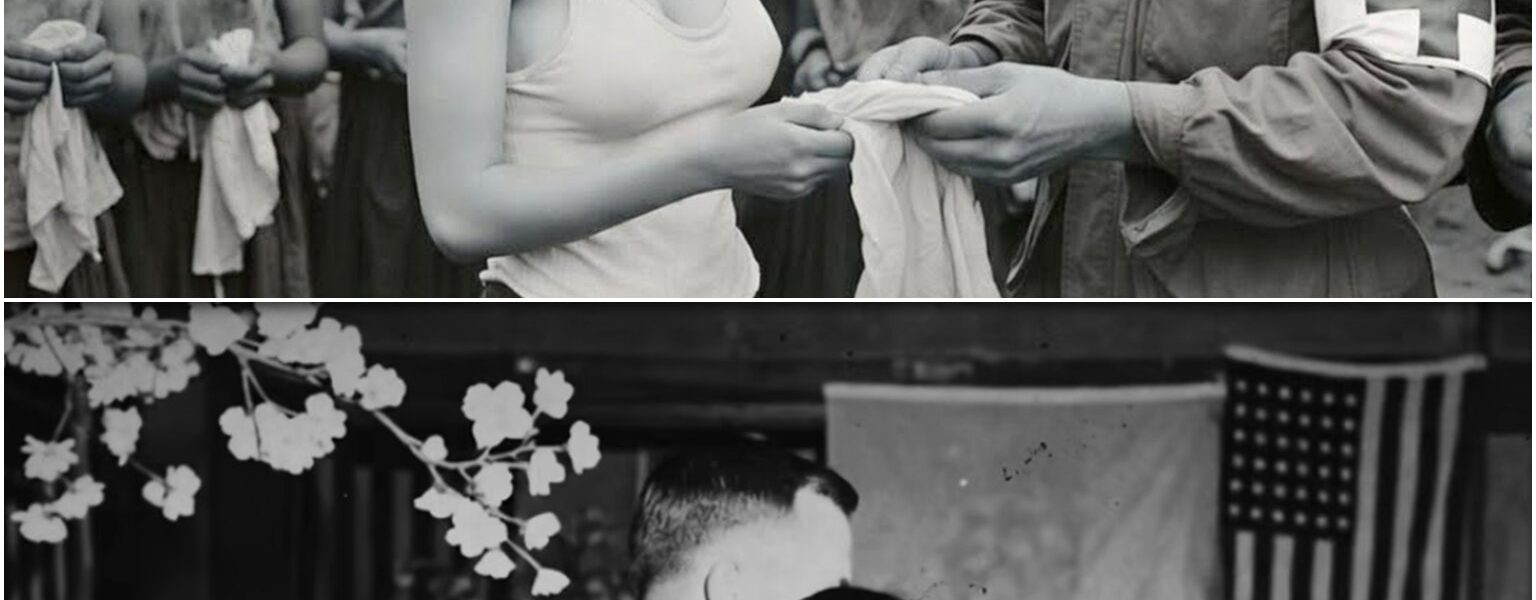
The women standing there had endured months of uncertainty at the collapsing edge of a global conflict. They had been told many things about the approaching enemy. They had been warned to expect humiliation, cruelty, and perhaps worse. Instead, in front of them stood a rough wooden structure, freshly assembled from salvaged planks and canvas sheets. A line of American medics stood nearby, awkward and dusty, tools still hanging from their belts.
The structure was a shower.
Not a grand one. Not luxurious. But functional. Private. Clean.
And built specifically for them.
In that fragile moment, something shifted—not only in the camp, but in the invisible boundaries that war had drawn inside the human heart.
This is the story of how a simple act of care stunned a group of Japanese prisoner women into tears, and how that unexpected gesture challenged deeply rooted beliefs on both sides of a brutal global conflict.

The Final Months of a Shattered World
By the final months of World War II, entire regions of the Pacific were exhausted. Cities lay in ruins. Supply lines were fractured. Civilians were displaced. Soldiers were scattered, retreating, surrendering, or simply trying to survive.
Among the chaos were women who had been part of military support units, medical auxiliaries, clerical corps, and labor groups attached to Japanese forces. When Allied troops advanced into certain territories, these women found themselves cut off from command structures and suddenly reclassified as prisoners of war.
Many had grown up immersed in a culture that emphasized honor, loyalty, and unwavering obedience. They had also been exposed to propaganda that portrayed the enemy as merciless and dishonorable. Capture, in their understanding, was a fate worse than death.
So when American forces took control of their region and gathered them into a temporary holding area, fear overshadowed everything.
They braced for degradation.
Instead, they were met with something entirely different.
Conditions in the Camp
The camp itself was not built for comfort. It was a hastily arranged perimeter of tents, supply crates, and medical stations. The climate was hot and thick with humidity. Rain turned pathways into mud. Dust coated everything during dry spells.
The American medical units stationed there were already stretched thin. They were treating wounded soldiers from both sides, distributing rations, and trying to contain outbreaks of illness common in overcrowded conditions.
The women had been separated from combatants and placed under guard. They were provided food and water, though supplies were limited. Privacy, however, was nearly nonexistent.
For women raised in a society that placed high value on modesty, the lack of private washing facilities was deeply distressing. Bathing had always been a ritual of cleanliness and dignity. Now, they were left with buckets and improvised screens that offered little comfort.
Some of the American medics began to notice.
An Observation That Changed Everything
It was not a grand policy decision handed down from generals. It began with observation.
A young medic—records later suggest he had been a carpenter before enlistment—noticed that the women avoided washing during daylight hours. They waited until dusk or before dawn, trying to shield themselves from view.
He mentioned it to his superior.
The idea was simple: build a basic shower enclosure using available lumber and canvas. It would require manpower and time. Both were in short supply. But from a practical standpoint, improved hygiene would reduce illness. From a human standpoint, it might restore a measure of dignity.
Permission was granted.
Within two days, a small team assembled a wooden frame, rigged water drums above it, and strung heavy canvas around the sides. It was crude but sturdy. Drainage trenches were dug. A rotation schedule was quietly prepared.
The structure stood ready.
The Moment of Revelation
When the women were informed—through an interpreter—that the facility had been constructed for their use, there was silence.
They did not rush forward.
They did not cheer.
They stared.
One woman stepped closer, examining the wooden posts. Another touched the canvas curtain. A third asked the question that would later echo in memoirs and testimonies:
“Is this really for us?”
The interpreter relayed the answer.
“Yes.”
No conditions. No humiliation. No spectacle.
Just yes.
Tears came suddenly, unexpectedly. Some covered their faces. Others bowed their heads. A few simply stood still, overwhelmed.
The American medics shifted uncomfortably. They had built a shower. They had not anticipated that it would feel like dismantling a wall built by years of fear.
The Power of a Small Mercy
War is often told through stories of strategy, heroism, and devastation. Yet the most enduring transformations sometimes occur in moments so small they barely register in official reports.
This shower was not a grand diplomatic gesture. It did not alter the course of the war. It did not erase suffering.
But it disrupted a narrative.
For the women, it contradicted everything they had been taught about their captors. They had expected cruelty. They received consideration.
For the American medics, it humanized individuals who had previously been described only as part of an opposing force.
In that shared space—between planks of wood and falling water—enemy and prisoner became something else.
They became human beings navigating the same shattered world.
Cultural Context and the Meaning of Cleanliness
To understand the depth of the women’s reaction, one must understand the cultural importance of bathing in Japan.
Bathing was not merely hygienic. It was spiritual, communal, restorative. From childhood, many had been accustomed to structured routines that emphasized cleansing the body as a way of preserving personal honor and social harmony.
To be deprived of that practice—especially in a vulnerable state of captivity—was more than physical discomfort. It was a symbolic stripping away of identity.
The shower, though rudimentary, restored a fragment of that identity.
It offered privacy in a place defined by surveillance.
It offered warmth in a setting marked by uncertainty.
It offered normalcy in a time when normal life had collapsed.
Breaking Through Propaganda
Both sides of the conflict had engaged in intense propaganda campaigns. Posters, radio broadcasts, and military briefings often painted the enemy in exaggerated, dehumanizing terms.
The women had been warned that surrender would lead to disgrace. They had been told that capture would bring humiliation.
Instead, they encountered medics who addressed them through interpreters, who provided medical treatment when necessary, and who built a shower without fanfare.
The Americans, too, had absorbed simplified narratives about the adversary. Many had lost friends in brutal battles. Resentment ran deep.
Yet face-to-face interaction complicated those narratives.
It is difficult to maintain caricatures when confronted with individual stories, quiet tears, and shared vulnerability.
The Emotional Release
When the first group used the shower, guards respectfully kept their distance. Water poured from the suspended drums, cool and steady.
Some women wept openly. Not because of the water itself, but because it signaled something they had not expected: they were not being reduced to objects of revenge.
One later account described how the sound of falling water mixed with soft sobs. Another recalled women standing under the stream longer than necessary, as if trying to wash away not just dirt but months of dread.
Outside, the medics pretended to busy themselves with other tasks. They understood that the moment did not belong to them.
But they also understood that something profound had occurred.
A Shift in Camp Dynamics
In the days that followed, tensions within the camp noticeably eased.
Conversations through interpreters became less rigid. Requests for medical attention were made more freely. The women began organizing cleaning schedules around the shower, taking responsibility for its upkeep.
American personnel observed fewer signs of silent resistance. Instead, there was cautious cooperation.
The shower had created a shared point of respect.
It was not an erasure of conflict. The war still raged elsewhere. News of devastation continued to filter in. But within that small perimeter of fencing and tents, a different model of interaction was emerging.
The Broader Framework of Military Conduct
The treatment of prisoners during World War II varied widely depending on location, leadership, and circumstance. In many theaters, conditions were harsh and unforgiving.
Yet there were also efforts—particularly among medical units—to adhere to established conventions regarding the care of prisoners and civilians.
The decision to build the shower aligned with those principles. Hygiene was directly connected to disease prevention. Disease could spread rapidly in confined camps, affecting captives and captors alike.
Thus, what began as a humane impulse also had practical implications.
But practicality alone does not explain the emotional weight of the gesture.
It was the intention—visible and undeniable—that transformed it.
Memory and Silence
For years after the war, stories like this rarely appeared in headlines. The dominant narratives focused on battles, political decisions, and reconstruction.
Moments of quiet mercy were often overshadowed by larger events.
Some of the women returned home to a country grappling with loss and transformation. Many spoke little of captivity. Cultural stigma around surrender persisted.
On the American side, medics demobilized and resumed civilian lives. They carried memories of exhaustion, chaos, and fleeting acts of kindness.
The shower was seldom mentioned in official after-action reports. It was a footnote in personal diaries.
Yet in interviews conducted decades later, it resurfaced as a defining memory.
Why This Story Matters Now
In an era saturated with polarized narratives, this episode offers a reminder that even amid extreme conflict, individuals retain the capacity for empathy.
The women’s tears were not a sign of weakness. They were a release of tension built by fear and misinformation.
The medics’ decision was not a political statement. It was an acknowledgment of shared humanity.
Today, historians increasingly examine these micro-histories—small interactions that complicate simplified accounts of war.
They reveal that conflict is not solely a clash of armies, but a mosaic of human choices.
Reconstructing the Scene
Imagine the heat pressing down on canvas tents. The smell of damp earth. The distant rumble of transport vehicles. The weight of uncertainty hanging in the air.
Now imagine the sound of hammers striking nails. The scraping of wood against wood. The quiet concentration of men assembling something not designed to harm, but to help.
The contrast is striking.
In a landscape shaped by destruction, construction took on a different meaning.
Each plank represented effort redirected from combat to care.
Each nail hammered into place symbolized a small stand against the total dehumanization that war threatens to impose.
The Psychology of Unexpected Kindness
Psychologists studying conflict often note that unexpected kindness can have a profound destabilizing effect on entrenched hostility.
When individuals are prepared for cruelty, compassion can feel almost disorienting.
For the women, the shower forced a reassessment of beliefs instilled over years. It did not instantly transform worldviews, but it cracked open the possibility that reality was more complex than propaganda suggested.
For the medics, witnessing the emotional reaction reinforced the idea that their actions mattered beyond immediate practicality.
This reciprocal recognition formed a fragile but meaningful bridge.
The Role of Interpreters
Communication was essential.
Interpreters played a quiet yet crucial role in ensuring that intentions were clearly conveyed. Without accurate translation, suspicion might have lingered.
The simple affirmation—“Yes, it is for you”—carried enormous weight.