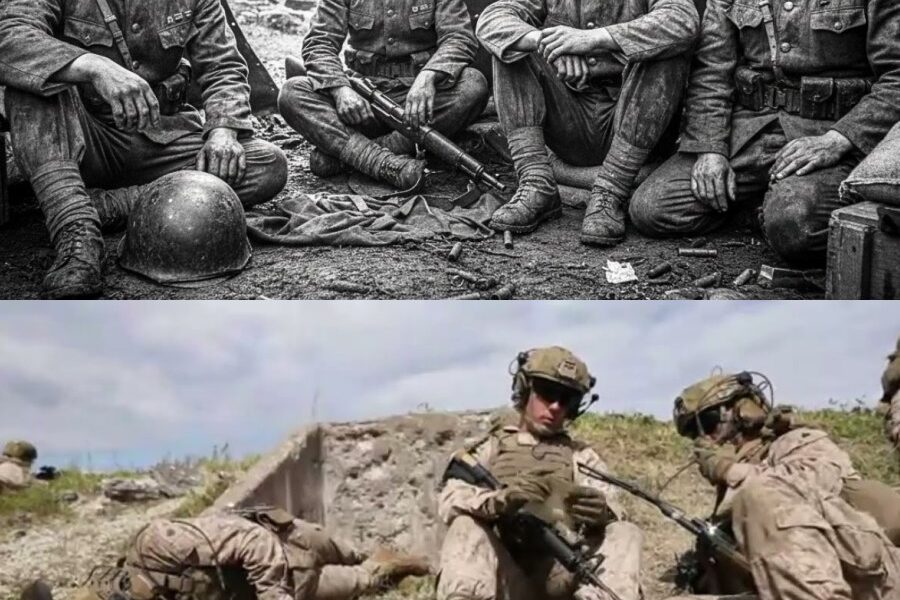


What Korean Soldiers Said When They First Fought US Marines
November 1950 at the Chosen Reservoir, North Korea, 120,000 Chinese and North Korean soldiers have completely surrounded 15,000 US Marines in minus 35 degree darkness. And every communist commander on that frozen battlefield was absolutely certain these Americans would collapse, surrender, or die within hours.
But when the battle was finally over, the surviving enemy soldiers weren’t celebrating. They were shaken, confused, and asking their officers the same desperate question. What exactly did they tell you about the Marines before you sent us up that mountain? November 1950, North Korea, the Chosen Reservoir. You clicked on this video because you want to know what Korean soldiers said when they first came face tof face with US Marines.
And we are going to tell you exactly that. But here is something your history teacher probably never told you. The Korean soldiers who fought the Marines first passed their warnings up the chain of command. And those warnings went all the way to the Chinese generals who sent 120,000 men into those frozen mountains. Every word those soldiers said, every confession, every desperate warning that got ignored.
Stay right here because what they said and what happened when nobody listened will change the way you think about courage forever. But first, you need to understand just how bad things looked before the Marines ever fired a single shot. It was the kind of cold that kills you before you even know you were dying.
The temperature at the Chosen Reservoir in November 1950 dropped to 35° below zero. Not cold like a winter morning. Not cold like you forgot your jacket. This was the kind of cold where the water in your canteen froze solid in minutes. Where the oil in your rifle seized up and the weapon simply stopped working.
Where men fell asleep and never woke up. The wind came screaming down from the mountains like something alive and angry, and it cut straight through every layer of clothing a soldier had on his body. The ground was frozen so hard that shovels bent when soldiers tried to dig fighting holes. The snow was so deep in some places that men sank to their waists trying to walk through it.
This was not a battlefield. This was the edge of the earth. And into this frozen nightmare, 120,000 Chinese soldiers were moving in the dark. They came at night on foot without trucks or tanks making noise. They carried their weapons and their orders and almost nothing else. Their commanders had told them something very specific before they left.
They had told them that American soldiers were soft, that Americans came from a rich country full of comfortable things, and that when the fighting got truly hard, when the cold got truly unbearable, the Americans would break. They would surrender. They would run. This was not a guess. This was the official belief of the Chinese military command in the fall of 1950.
It was built on what they had seen so far in the war. And what they had seen gave them every reason to feel confident because the truth was the early months of the Korean War had been a disaster for American forces. When North Korea crossed the 38th parallel on June 25th, 1950, they came with 135,000 soldiers and 150 Soviet T34 tanks.
These tanks were tough, fast, and nearly impossible to stop with the weapons American soldiers carried at the time. South Korean forces crumbled in days. The capital city of Seoul fell in just 3 days. And when the United States rushed its first ground troops into Korea to stop the collapse, the results were catastrophic.
Task Force Smith, a small group of American soldiers sent to slow the North Korean advance, was destroyed in a matter of hours on July 5th, 1950. They fought hard. They were brave, but they were outnumbered, outgunned, and overwhelmed. They lost nearly 150 men killed, wounded, or captured in a single morning.
The North Koreans barely slowed down. General Douglas MacArthur, the most famous American military commander of the time, stood in his headquarters and told everyone who would listen that it would all be over quickly. He told President Truman the troops would be home by Christmas. His staff agreed. The experts agreed.
The newspapers repeated it. The feeling in American command was that this was not a real war. It was a small problem that would be solved fast. Nobody at the top seemed to understand just how wrong they were. Then the Marines arrived. The first Marine Division came ashore at Busan in August 1950 and they were different from the very first moment.
These were not fresh recruits who had never seen a real fight. These were men who had crawled across the black sand beaches of Ewima under machine gunfire. Men who had fought handto hand in the jungles of Guadal Canal. men who had watched their friends die in places with names most Americans could not even pronounce. The Marine Corps had built these men through years of the hardest training in the American military, and it had shaped them into something the North Koreans and Chinese command had not fully studied and had not fully understood.
Their commander, Major General Oliver Prince Smith, was a quiet man with glasses and a calm voice. He did not yell. He did not give big speeches, but he watched everything. He noticed things. And one of the first things he noticed about the North Korean and Chinese tactics was that they were rigid, predictable.
These enemy forces had been trained in Soviet military methods. And those methods relied on doing the same things in the same order every time. wave attacks, night charges, overwhelming numbers pushing straight forward. It worked against enemies who panicked. It worked against enemies who broke and ran.
General Smith looked at those tactics and saw something that his superiors had missed entirely. He saw a pattern, and he began to prepare his Marines for what was coming. He slowed his division’s advance north. Other commanders pushed him to move faster. MacArthur’s headquarters wanted speed. Smith refused to rush. He stockpiled supplies.
He kept his units close together instead of spreading them thin across the frozen mountains. His fellow officers thought he was being too cautious. Some were frustrated. One general reportedly questioned his nerve. Smith said nothing and kept building his stockpiles and keeping his men tight. He had a feeling about what was waiting up in those mountains above the Chosen Reservoir. He could not prove it yet.
Nobody would have believed him if he tried. But Oliver Smith had fought enough battles in enough terrible places to recognize the quiet before something enormous was about to happen. And in the dark frozen hills above him, 120,000 soldiers were already in position, already waiting, already absolutely certain that these Americans would fall apart the moment the attack began.
They had no idea what they were about to learn. General Oliver Smith did not wait for the enemy to teach him lessons. He started teaching his Marines first. While other American units were still trying to figure out why their tactics were failing, Smith was already changing his. He had watched what happened to Task Force Smith and the other early army units, and he saw a clear pattern in every defeat.
American forces were spreading out too thin, moving too fast, and leaving their supply lines exposed. When the North Koreans hit them, they had nowhere to fall back to and nothing to fall back on. They ran out of ammunition. They ran out of food. They ran out of options. Smith decided his Marines were going to do the opposite of all of that.
He started with supplies. Before the First Marine Division moved one step north toward the Chosen Reservoir, Smith ordered his men to build up a massive supply base at a small airirstrip called Hegar Rei, right at the southern tip of the reservoir. His superiors thought this was a waste of time. The war was supposed to be nearly over.
MacArthur’s command was pushing every unit to race north as fast as possible to reach the Yalu River at the Chinese border and end the whole thing before winter set in. Speed was everything. Supplies could come later. Smith ignored the pressure and kept building. He stockpiled ammunition, medicine, food rations, and cold weather gear at Hegari.
and he made sure that airrip was long enough to land cargo planes in an emergency. The other generals shook their heads. Smith kept stockpiling. He also changed the way his marines moved through the mountains. Instead of spreading his division across 50 m of frozen road like his orders suggested, Smith kept his units within supporting distance of each other.
No marine unit would be so far from another that it could be surrounded and destroyed before help arrived. The roads through those North Korean mountains were narrow, winding, and cut into the sides of cliffs that dropped hundreds of feet into frozen valleys below. One road in, one road out. Smith knew that if his men got too spread out on that single road, the whole division could be cut apart like links of a chain, one piece at a time.
So he kept them tight. His commanders above him were frustrated. One senior general sent word that Smith needed to move faster. Smith wrote back with careful, polite words and kept doing exactly what he had been doing. The man who understood Smith best was not another general. It was the Marines themselves.
These men had trained for close, brutal, grinding combat. Their entire system was built around the idea that when things go wrong, you do not retreat and wait for better conditions. You find a way to fight through the bad conditions with what you have right now. Marine training in 1950 included live fire exercises where real bullets passed overhead while men crawled through mud and cold.
It included forced marches of 20 m or more carrying full packs. It included hand-to-hand combat training and the constant message that the marine next to you was the most important person in the world and you would die before you left him behind. This was not just talk. It was built into every single day of how these men lived and trained.
By the time the first Marine Division arrived in Korea, this way of thinking was as natural to them as breathing. The first real test came in August and September of 1950 at the Busan perimeter. North Korean forces had pushed the entire Allied line into a small corner of southeastern Korea around the port city of Busan. The perimeter was roughly 100 m long and 50 m wide.
Inside it were the last remaining South Korean and American forces in the country. Outside it were North Korean divisions that had been winning every single battle for two straight months. The pressure on the perimeter was enormous. North Korean commanders believed one more hard push would collapse the whole thing and end the war with a communist victory.
The Marines were thrown directly into the hardest part of the line. At the Battle of Obongi Ridge in August 1950, Marines attacked a heavily defended hill that North Korean forces had held for days. The ridge was steep, rocky, and covered with machine gun positions that had already stopped previous attacks cold.
The Marines went up anyway. They moved in coordinated rushes, covering each other with fire, pushing forward a few yards at a time. When they took casualties, they did not stop. When the North Koreans counteratt attacked, the Marines counteratt attacked right back. In two days of savage fighting, the First Marine Division took the ridge, held it, and broke the North Korean assault in their sector.
North Korean commanders in the area reported to their superiors something that had not come up much before in the war. These soldiers did not behave the way the others had. They came forward under fire instead of pulling back. They fought at night as well as during the day. They were hard to break. Then came Inchan.
On September 15th, 1950, the First Marine Division executed one of the most difficult military landings in history. The port of Inchan had tidal waters that rose and fell 32 ft, leaving massive mud flats exposed for most of the day. The window to land troops and equipment was only about 2 hours at high tide, twice a day.
Naval experts said it was too risky. Military planners said the timing was too tight. MacArthur said to do it anyway, and the Marines were the ones who made it happen. 75,000 troops went ashore. The Marines led the assault, crossing the mud flats and small landing craft, climbing over seaw walls on metal ladders and fighting their way into the city street by street.
Within 2 weeks, Seoul was back in Allied hands. The entire North Korean army, which had been pressing down on Busan, suddenly found its supply lines cut and its escape routes closing. Thousands surrendered. Thousands more were captured or killed trying to retreat north. Captured North Korean soldiers were brought in for questioning.
And the intelligence reports that came back carried something American officers found deeply interesting again and again. Prisoners said the same thing in different ways. They had been told the Americans would not fight hard. They had been told the Marines were no different from the other soldiers they had already beaten.
One prisoner, a North Korean infantry sergeant captured after the fall of Seoul, told his interrogators something that was written down in an official US intelligence debrief. He said his commanding officer had told his unit before the war began that Americans live too well to fight well. That comfort made men weak. That a soldier raised on hardship would always beat a soldier raised on plenty.
He had believed it completely, he said, until he watched Marines walk straight into machine gunfire at Obongi Ridge without slowing down. That was when he stopped believing it. These North Korean soldiers were the first to learn the lesson. Their reports went up through the military chain. Whether those reports reached the Chinese generals who were already moving toward Korea in secret is one of the most important questions of the entire war.
Because the answer, as 120,000 Chinese soldiers were about to discover in the coldest mountains on Earth, appears to have been no. The bigger test was still coming, and it was waiting for them at the reservoir. The night of November 27th, 1950 was the kind of dark that has no bottom to it. There were no city lights anywhere near the Chosan Reservoir, no street lamps, no headlights, just black sky, black mountains, and a cold so deep and so total that it felt like the Earth itself was trying to kill every living thing on its surface. The temperature
had dropped to 35° below zero. The wind moved across the frozen reservoir in long, sweeping gusts that stole the heat from a man’s body in seconds. Marines crouched in their fighting holes and pulled their jackets tighter and breathed through scarves wrapped around their faces, watching the darkness and listening.
Some of them could not feel their feet anymore. Some of them could not bend their fingers. The morphine in the medic bags had frozen solid and could not be used to treat the wounded. Sea ration cans were frozen into blocks that could not be opened without a knife and a lot of effort. And even then, the food inside was so cold it gave men stomach pain to eat it.
And then the bugles started. That was how the Chinese signaled their attacks. Not radios, not flares, bugles. The sound came out of the darkness from every direction at once, high and sharp and wrong, in a way that hit something deep in a man’s chest. Then came the whistles. Then came the shouting. And then 120,000 Chinese soldiers from the people’s volunteer army came pouring out of the hills and down onto the roads and into the marine positions from the north, the south, the east, and the west all at the same time. The Chinese 9inth
Army Group had been planning this attack for weeks. Their commander, General Song Shiun, had 12 full divisions. He had positioned them in the mountains around the Chosen Reservoir without the Americans ever detecting them. No campfires, no vehicle engines. They had moved entirely on foot at night in complete silence through some of the most brutal mountain terrain on Earth.
Song Sheilan believed he had everything he needed to destroy the first Marine Division in a single night. He had the numbers. He had the surprise. He had the darkness. and the cold working in his favor. His men had been told that the Americans inside that perimeter would panic when they realized they were surrounded and outnumbered 10 to1.
His men had been told this would not take long. What happened instead would be studied in military schools for the next 70 years. The Marines did not panic. They did not run. In the first hours of the attack, when Chinese forces hit the marine positions at Udemy on the western side of the reservoir, the Marines fought back with a ferocity that stopped the assault cold.
Two marine regiments, the fifth and the seventh were at Udemy with roughly 8,000 men between them. Chinese forces hit them from three sides with an estimated 20,000 soldiers in the first wave alone. The noise was overwhelming. Gunfire, grenades, bugles, shouting, the screaming of wounded men in two languages mixing together in the frozen dark.
Marines who ran out of ammunition in their rifles fixed bayonets and kept fighting. Small groups of men were cut off from the main positions and fought through the night completely alone, back to back in temperatures that froze the blood in open wounds within minutes. By morning, the Chinese had not broken through.
This was the moment that began to change everything the Chinese soldiers believed about who they were fighting. Their officers had told them the Marines would collapse under a night assault. The Marines had not collapsed. Their officers had told them the cold and the darkness would destroy American morale.
The Marines had fought harder in the dark than they had during the day. Chinese unit commanders began sending back reports that described something their training had not prepared them for. One report, later captured and translated by American intelligence, described the Marines as advancing toward enemy fire rather than away from it.
Another described Marine units that had been completely surrounded, continuing to attack outward in multiple directions at once. The language in these reports was careful and military, but the confusion underneath it was clear. These men were not behaving the way Americans were supposed to behave. At Hagari, the supply base that General Smith had been quietly building while his superiors complained about his slow pace.
The situation was desperate but not lost. Only a single under strength battalion of Marines and some army troops held the perimeter there. Roughly 2,500 men facing thousands of Chinese attackers every night, but Smith’s airirstrip held. Cargo planes came in under fire during the day, landing on a strip of frozen dirt cut into the mountains, delivering ammunition and supplies and taking out the wounded.
Between November 27th and December 11th, those planes flew out over 4,500 casualties. They flew in tons of supplies. That airirst strip, which every senior commander above Smith had considered unnecessary, was the reason the Marines survived. On December 1st, the two Marine regiments at Udomni began fighting their way south toward Hagaruri along 14 miles of frozen roads surrounded by Chinese forces on every ridge above them.
They brought their dead with them on trucks. They brought every one of their wounded. They fought through ambush after ambush, moving in disciplined formations that covered each other and never left anyone behind. It took 59 hours. When they finally came through the gates at Hagari, the Marines already there stood and watched them come in.
Men who had been fighting for days without sleep, with frostbitten hands and faces, with wounds that had been dressed in the field and not properly treated, walking in formation, carrying their weapons, carrying their dead. An army officer present that day wrote in his personal journal that watching those Marines come in was the most remarkable thing he had ever seen in 20 years of military service.
The Chinese soldiers watching from the ridges above saw something different. They saw men who were supposed to be beaten, still fighting. They saw an army that was surrounded and should have surrendered, still moving, still organized, still dangerous. Captured Chinese soldiers taken during the breakout were questioned by American intelligence teams, and their answers were striking.
One prisoner said his company commander had told them the Marines would surrender when they realized escape was impossible. Another said his unit had expected the Marines to abandon their equipment and their wounded and try to slip away in the dark. When asked what they thought now after fighting these Marines for 2 weeks, multiple prisoners used versions of the same idea.
They said they had not been told the truth about these soldiers. They said nobody had warned them. They said if they had known, they were not sure their commanders could have convinced them to attack at all. The Chinese 9inth Army Group suffered an estimated 40,000 casualties during the Battle of Chosen Reservoir. Some estimates put the number higher.
The entire force was so badly damaged that it was pulled out of combat and did not fight again for months. The First Marine Division suffered approximately 4,400 battle casualties of their own, and another 7,000 men were treated for frostbite and cold weather injuries. But they came out, all of them, carrying their weapons, carrying their wounded, carrying their dead.
A Marine officer, Colonel Lewis Chesty Puller, said it the way everyone would remember. When told his regiment was surrounded, he reportedly said they could attack in any direction they wanted because the enemy was on all sides. It was not bravado. It was not a performance for the press. It was the actual way these men thought.
And it was the thing that the Chinese command for all its planning and preparation and overwhelming numbers had never once thought to plan for. The Marines reached the sea on December 11th, 1950. They came down out of the mountains at a place called Hungnam on the northeastern coast of North Korea. And what waited for them there was a fleet of ships and a world that felt almost impossible to believe in after everything they had just survived.
Warm food, dry clothes, medical care that did not have to be performed with frozen hands in the dark. Men who had not slept more than a few hours in two weeks sat down on the decks of Navy ships and stared at nothing for a long time. Some of them cried. Some of them ate and immediately fell asleep sitting up.
Some of them looked at their hands at the black frostbitten fingers and the cracked and bleeding skin and seemed surprised that those hands were still there at all. They had walked 78 miles in 14 days through mountains and ambushes and temperatures that should have killed them. And they had come out the other side with their weapons, their wounded, and their dead.
The world took notice immediately. Newspapers across the United States ran the story of the chosen breakout on their front pages. Military observers from a dozen different countries sent reports back to their governments trying to explain what had happened. How does a force of 15,000 men walk out of an encirclement by 120,000 soldiers? How do men fight effectively in temperatures that freeze weapons and shatter morale and make every single physical task a battle against the body itself? Military analysts wrote long reports
full of careful language, but most of them kept coming back to the same simple answer. The Marines had done something that could not be fully explained by numbers or tactics or equipment. They had refused, in the most basic and complete sense of the word, to stop. But the story did not end at the W’s edge. The Korean War continued for nearly three more years, dragging on through 1951 and 1952 and into the summer of 1953 when an armistice was finally signed on July 27th of that year.
The line between North and South Korea settled almost exactly where it had been before the war started, near the 38th parallel, which meant that millions of people had fought and died and frozen and bled to end up more or less where they began. For many Americans, that fact made the whole war feel unfinished, unsatisfying.
The veterans who came home from Korea did not receive the parades and the celebrations that World War II veterans had received 5 years earlier. They came home to a country that was already moving on to other things, that was not entirely sure what had been won or lost or why it had mattered. Korea became known as the forgotten war.
And for a long time, that name stuck harder than any of the battle names that came with it. The men of the First Marine Division carried that with them for decades. General Oliver Smith, the quiet man with glasses who had stockpiled supplies and kept his units tight and refused to rush and been right about all of it, retired from the Marine Corps in 1955.
He did not become a household name. He did not write a best-selling book or appear regularly on television. He gave interviews occasionally and spoke at military functions and answered questions about Chosen with the same calm, careful voice he had used to give orders on that frozen road. He said once that he had never doubted his Marines.
He said the only thing he had ever truly worried about was whether he had done enough to give them what they needed to do what he already knew they were capable of doing. He died in 1977 at the age of 84. Respected deeply inside the military community and largely unknown outside of it. Chesty Puller, whose words about attacking in every direction became one of the most repeated quotes in Marine Corps history, went on to become the most decorated Marine in the history of the United States military.
He received five Navy crosses across his career, a record that has never been matched. He retired in 1955 as well, and he spent his later years as a kind of living legend inside the core, the physical embodiment of everything the Marines believed about themselves. He died in 1971 and to this day his name is spoken at Marine bases around the world in a way that sounds less like history and more like a promise.
The Chosen Reservoir became a permanent part of Marine Corps identity. In a way that few battles ever become part of any military’s identity. It is not just remembered, it is used. Marine drill instructors tell the story of Chosen to recruits who are cold and exhausted and wondering if they can keep going. The message is always the same.
Other men were colder than you are right now. Other men were more tired. Other men were more surrounded and more outnumbered and more alone in the dark. And they kept going. And you come from them. And so you will keep going too. This is not mythology. It is a direct line drawn from one generation of Marines to the next.
And it has been drawn continuously for more than 70 years. The Chinese military drew its own lessons from Chosen, though those lessons took longer to be spoken out loud. In the decades that followed the Korean War, Chinese military historians and strategists wrote extensively about what went wrong at the reservoir. The most consistent conclusion they reached was not about tactics or weapons or supply lines. It was about assumptions.
The Chinese command had built their entire plan around a version of the American soldier that did not match the actual American soldier they encountered. They had studied American consumer culture and American comfort and American reluctance to suffer. and they had concluded that Americans would not endure true hardship when it came.
They were right about some Americans in some places. They were completely and catastrophically wrong about these Marines in this place. The lesson Chinese military planners took from that error was simple and brutal. Never assume you know your enemy based on where he comes from. Find out who he actually is before you decide what he will do under pressure.
That lesson applies so far beyond war that it is almost uncomfortable to say out loud. Every single day in businesses and schools and families and relationships, people make the same mistake the Chinese command made at Chosen. They look at someone from the outside. They see where that person comes from, what they have, how they were raised, what the world around them looks like, and they decide based on all of that what that person will do when things get truly hard.
They assume the comfortable person will quit. They assume the outnumbered person will surrender. They assume the surrounded person will stop fighting. And sometimes those assumptions are right. But sometimes the person they are looking at has been quietly building supply depots in their mind for years.
Sometimes that person has trained for the cold and the dark in ways nobody bothered to notice. Sometimes that person is already thinking about which direction to attack from. The Chinese soldiers at Chosen asked their commanders why they were never warned about the Marines. It is a fair question. But the deeper question is the one that keeps echoing forward through time.
Past 1950, past the frozen reservoir, past all the wars that came after. How often do we fail? Not because we lacked strength, but because we completely misjudged the strength of the person standing across from us. The Marines already knew the answer. They had known it since before the bugle started. They just kept it to themselves and let the cold dark night do the explaining for them.