

“She is only 16, put her inside.”
That was the order the German commander gave when he saw the girl in Room 13.
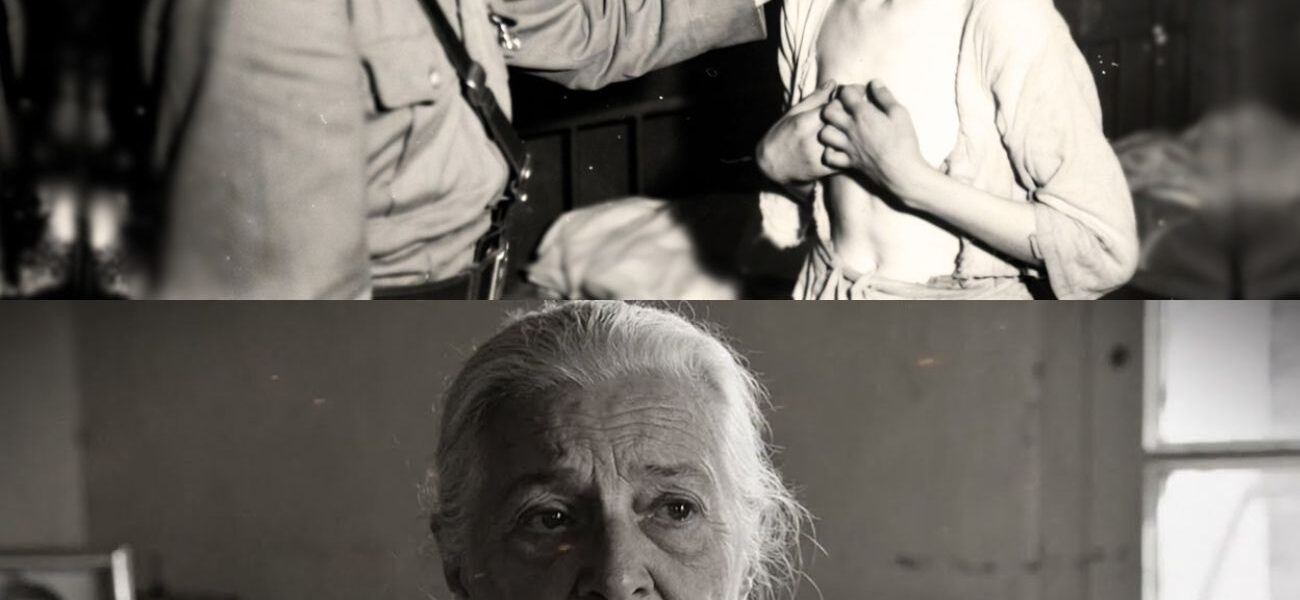
I was sixteen when a German officer walked into the kitchen of our house, pointed at me the way someone chooses fruit at a market, and told my father that I had been requisitioned for administrative service at the prefecture of Lyon.
My mother squeezed my hand so tightly that I felt my bones crack. My father could not look me in the eyes. We all knew it was a lie. We all knew I would not come back the same, and we also knew there was no choice.
It was March 1943. France had been occupied for three years, and Nazi Germany did not ask permission for anything—it simply took.
My name is Bernadette Martin. I am 85 years old, and I want to tell you something that very few history books have dared to write clearly. When we talk about the World War II, we speak about battles, invasions, and heroic resistance. But we rarely speak about what happened on the upper floors of requisitioned hotels, in numbered rooms, in beds where girls like me were turned into silent fuel for the German war machine.
They did not call it rape; they called it “service.”
They did not call us victims; they called us “resources.”
And the commander, Hauptmann Klaus Richter—a 45-year-old man, married, father of three children in Bavaria—did not consider himself a monster. He believed he was simply exercising a conqueror’s right.
He chose the youngest. He used to say that fresh skin eased the pressure of war.
And I, with my French farm girl’s face, my long brown hair, and the innocence visible in my eyes, was chosen to be his—exclusively his—for eight months in Room 13.
Every Tuesday and Friday, precisely at 9:00 p.m., like a medical appointment, like a bureaucratic routine, as if my body were a document to be stamped.
Now, as I say this while sitting in a chair in front of a camera, I know my voice may sound cold. I know I may appear distant. But you must understand something: after sixty-two years of carrying this burden alone, after decades of pretending it never happened, after building an entire life on ruins that no one wanted to see, the only way I can tell this story is with the same coldness with which it was imposed on me.
Because if I allow emotions to enter now, I will not finish. And this story must be told.
Not for me, but for the others:
for those who lost their minds,
for those who took their own lives,
for those who gave birth to children they never asked for,
for those who returned home only to be called traitors, collaborators, “German whores,”
for those who could never again feel their own bodies without disgust.
But these were not ordinary brothels.
They were organized, hierarchical, medicalized structures.
There were medical records, scheduled hours, daily quotas.
There were rules.
There was absolute control.
And there were us, the women.
Some were recruited by force like me.
Others were brought from prisoner camps.
Others were traded in exchange for food or protection for their families, for empty promises of future freedom.
I knew nothing about all of this when I first entered that hotel. I only knew that my life ended the moment the officer pointed at me.
In the military truck that brought me there, there were five other girls. None of us spoke. The silence weighed like lead.
It was raining, I remember, because the water struck the canvas cover and created a hypnotic rhythm, almost comforting, as if the outside world were still normal.
But when the truck stopped, when the doors opened and I saw that imposing building with Nazi flags hanging at the entrance and armed soldiers standing on both sides, with the artificial elegance of a hotel that no longer welcomed ordinary guests, I understood that I was entering a different kind of prison.
A prison where the bars were invisible.
A prison where torture left no visible marks.
A prison where people died slowly, in silence.